



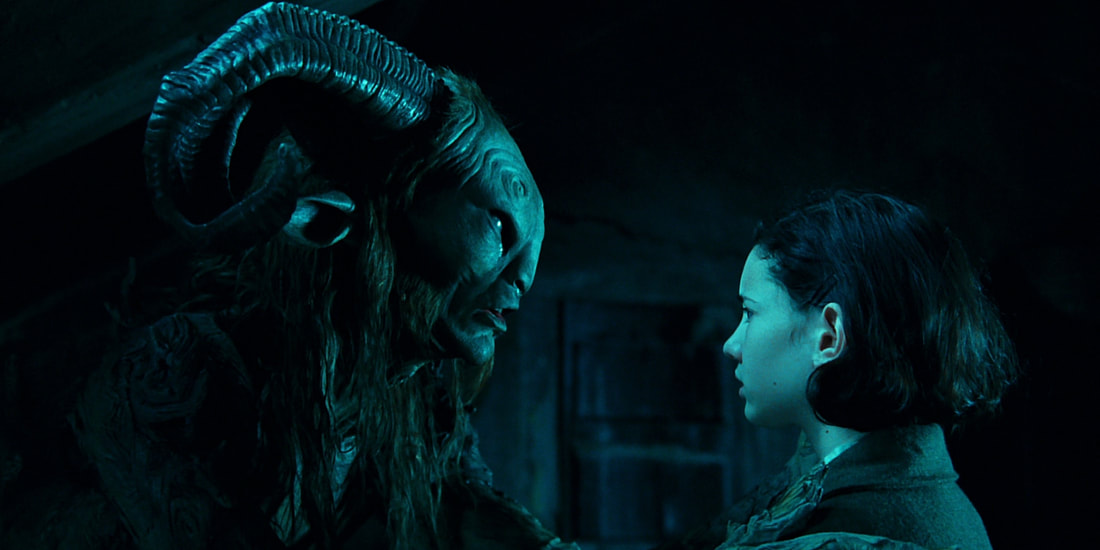
THE STORY – In 1944 Spain young Ofelia (Ivana Baquero) and her ailing mother (Ariadna Gil) arrive at the post of her mother’s new husband (Sergi López), a sadistic army officer who is trying to quell a guerrilla uprising. While exploring an ancient maze, Ofelia encounters the faun Pan, who tells her that she is a legendary lost princess and must complete three dangerous tasks in order to claim immortality.
THE CAST – Sergi López, Maribel Verdú, Ivana Baquero, Doug Jones, Ariadna Gil & Álex Angulo
THE TEAM – Guillermo del Toro (Director/Writer)
THE RUNNING TIME – 119 Minutes
11/30/17
By Nguyen L.
Ever since his biting spin on immortality and vampirism in “Cronos,” Guillermo del Toro has been an essential name in one’s cinematic intake. Mind-numbingly few are filmmakers like him. Few try to keep the crux of celluloid magic alive with ideas plucked from their own imagination and realized through practical effects. While it’s assured that bliss resides within every point of del Toro’s criminally light filmography, this sensation is at its best in his 2006 masterpiece, “Pan’s Labyrinth.”
1944, post-Civil War Spain. Curious 11-year-old Ofelia (Ivana Baquero) moves with her ailing yet expecting mother (Ariadna Gil) to an old mill deep in the woods, which is also the headquarters of her stepfather, the noted Falange Captain Vidal (an intimidating, truly scary Sergi López). There is little love here, though, as the man clearly sees her as a nuisance and her mother as nothing more than a broodmare. One night, Ofelia follows a bizarre critter, a fairy, into a mystical labyrinth not far from the house, where a faun (Doug Jones, voiced by Pablo Adán) from a kingdom beyond reveals she is the truant princess he has been waiting to retrieve. As a way to ensure Ofelia’s blood is actually royal, the Faun gives her three dangerous tasks to be done before the coming full moon. Real or not, Ofelia doesn’t care; she’d rather have an adventure than another dirty look from Vidal or another tedious day on the (so far) quiet property.
Guillermo del Toro’s brutal, breathtaking, and magical finest hour isn’t kid-friendly. Yes, production designer Eugenio Caballero and set decorator Pilar Revuelta have everything at their disposal to spellbind any young’un, let alone Ofelia, but in a flash, they can switch to a lurid look at real-world brutality that will haunt the mind. Within the Academy Award-winning cinematography, either a cool blue or blazing gold dominates the frame, sometimes both, turning the atmosphere into a calming-yet-heightening wave that makes the setting’s slips between two realities as seamless as possible. It’s a surefire way to have us, regardless of our age, see life through Ofelia’s eyes, both through her visions of the harsh world around her, ravaged by pain and war, and the fantastical one she visits throughout the film, guided by Faun.
It comes with the del Toro territory that the makeup department operates on the exceptional-to-extra-exceptional range here. Their work also earned them an Academy Award as well. Had their hulking Mr. Wink and the grandiosely gothic Angel of Death in “Hellboy II” (To be released two years later) never come to be, “Pan’s Labyrinth” would have remained home to the filmmaker’s finest mythical creations. And even if creatures aren’t involved, the work of del Toro regulars David Martí and Montse Ribé is just as impressive; signs of forceful physical alterations and scars will elicit winces and, in the latter half, may prompt a scavenger hunt for Advil. The violence in the film is graphic and contrasts sharply with how cold, unmerciful, and dark the real world is compared to the child’s imaginary one they conjure at a young age. As such, del Toro is showcasing a young girl’s transition into a woman, as she must mature her perceptions and understand how unforgiving the world truly is. The film’s ending, however, breaks our hearts in more ways than one when the real world’s bleak nature takes hold of Ofelia and robs her of further growth.
Whether the world on screen is one all can see or only Ofelia, every moment offers a taste of Guillermo del Toro’s cinematic vision. The music, the performances, the fantastical setting, the mature nature of the story- everyone reaches the peak of their creativity here. One sequence (of which there are many, but this one is a real standout) is so terrifying it reportedly made Stephen King squirm: Ofelia’s failure to follow the rules Faun sets out awakens a child-eating, eyes-in-palms monster called the Pale Man. Both creatures are played by del Toro favorite Doug Jones to mesmerizing effect, serving as both guide and threat.
“Pan’s Labyrinth” combines del Toro’s storytelling and love of all things cinema (not a single technical element is wasted) to create a foreign-language masterpiece that can rightfully be considered the Mexican director’s finest achievement yet. His latest film, “The Shape of Water,” uses many of the same elements that worked so perfectly in “Pan’s Labyrinth” and tailors them for an American audience, while never losing sight of why we love him and this film in the first place. Maybe del Toro is telling us that the world of fantasy (Or even the afterlife) is better than our own with “Pan’s Labyrinth.” Maybe he’s telling us there is both darkness and beauty within the world. Or maybe he’s telling us that losing yourself in a film isn’t too dissimilar from Ofelia’s journey into fantasy, life, and death. Whatever the message is, there is no denying the power, beauty, and brilliance of del Toro’s work.
THE FINAL SCORETHE GOOD – Top-notch production values across the board. Fantastic performances. Brilliant storytelling that may seem simple at first but becomes shockingly poignant as its mysteries and beauty unfold. THE BAD – Nothng THE FINAL SCORE – 10/10 |
|
10
FINAL SCORE |
