



THE STORY – As a cargo ship sails through a storm off the coast of Basse-Côte-Nord, a cook is found murdered on board. From the perspective of Alupa Tulugak, an Inuk mechanic and friend of the victim, this story reconstructs the events as a thriller.
THE CAST – Christopher Angatookalook, Alexandre Landry, Gabrielle Poulin B., Jassinth Thiagarajah & Arsaniq Deer
THE TEAM – Rodrigue Jean (Director/Writer)
THE RUNNING TIME – 120 Minutes
There is an intersection between the natural curiosity to explore a tale of criminality and the deeper analysis of the people who are involved. The true crime subgenre has invigorated a large section of the populace to become thrilled by scandalizing details of depraved acts, a peek inside a darker side of humanity that can be alluring to perceive at a safe distance. Yet these stories can sometimes lose the individuality at play. The details become sensationalized, and motivations are flattened. It becomes more difficult to perceive the genuine humanity at their core and to treat these characters as the complex humans they are. Anybody who watches “Labrador – Autopsy of Silence” expecting the heightened tone of a broad thriller will be disappointed. It is not a piece that is meant to operate in such a register. Instead, it finds a much more fulfilling narrative to showcase. The film becomes a meditative examination of the struggle to create close bonds within a hierarchy that remains distrustful of those it has otherized, and in turn becomes a compelling character study.
Though not entirely dramatized, the story is inspired by real-life events that took place over a decade ago. Here, the setting is aboard the Adeawiktak, a cargo freighter that is reaching the end of its season as it sails along Basse-Côte-Nord in Quebec. Alupa (Christopher Angatookalook) is an Inuk mechanic working in the engine room, often separated from much of the crew. His strongest bond is with Alex (Alexandre Landry), a cook with whom he is having a secret love affair. That relationship is strained by the presence of the ship’s first officer, Michelle (Gabrielle Poulin B.), who uses her position of authority to extract her own sexual favors out of Alex. That tension reaches a boiling point one morning when Alex is discovered to have been murdered in his quarters. As the murder investigation begins, Alupa comes under suspicion by law enforcement. The system ends up revealing not only the harsh realities that are thrust upon marginalized groups but also the deep emotions that still linger within these individuals as they cope with this profound loss.
The most intriguing aspect of the world that Rodrigue Jean creates is the overwhelming stillness that encapsulates the environment. This massive ship may be full of mechanical thuds as bone-chilling wind rips across the icy surfaces, but the quiet atmosphere is what allows these individuals to stew in their emotions. It’s an environment similarly depicted in Jean’s gay drama “Love in the Time of Civil War,” another grim peek into the disorganized lives of struggling individuals. The methodical pacing is evident right up top, with a detailed, graphic depiction of a seal being dismembered. While it may be hard to watch, it reflects the somber tone. The imagery is always murky, and the sounds are at a low rumble that constantly unsettles. The filmmaking mirrors the unease that permeates throughout this story, as the unfolding procedural soon becomes a commentary on a legal system that scrutinizes the Native community. The suspicion that falls upon Alupa goes beyond this one incident, as even the encampments where his family is forced to reside are on the receiving end of police harassment.
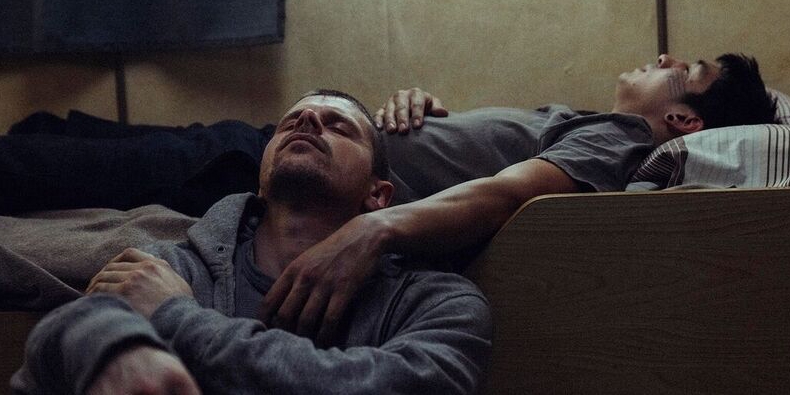
It’s a world that feels so cold and removed, as even the sex between Alex and Michelle is passionless and perfunctory. Only when the intimacy between Alex and Alupa is shown is a spark of intensity ignited. The former is often seen as a ghostly apparition that follows Alupa through his conflicts, a presence that at first raises suspicion about how genuine their connection truly was. This version is only ever perceived through the eyes of another, so there is room to interpret just how deep their own relationship ran. Either way, his lingering spirit represents the acute heartache this protagonist suffers through, mostly in silence, within a society that refuses to acknowledge any further complexity within. An affectionate shower that’s shared between the two of them, followed by a cuddle in bed, is the most affectionate depiction of their dynamic. It’s a sharp contrast to the dismissal of his basic humanity that permeates the rest of this landscape, and Jean captures this portrait effectively.
While there is nuance among many of the players in this narrative, the storytelling itself only goes so far in analyzing this more layered tapestry. A part of that is the blunt dialogue that often rears its head, mostly associated with the procedural aspects of the investigation. The legal and medical jargon never sounds that convincing, but it can be easy to brush that aside. It’s harder to look past some of the suppressed displays of emotion. It may be true that this is a thesis on the lack of hyperbolic outbursts, but one could be granted an exception when a brutally mangled dead body is discovered. The pre-trial section of the film also doesn’t maintain much momentum, stalling on bland testimonies that don’t illuminate much from either a plot or character progression perspective. This all adds to an inconsistent pace that sometimes threatens to become tedious. The more fascinating psychological expedition is occasionally hindered by an unimpressive dive into a more rigid procedure that Jean’s script struggles to make wholly engrossing.
Angatookalook’s performance is an incredibly strong anchor that holds the film together. There is so much inner turmoil that flashes across his eyes, constantly needing to maintain the stoic persona to mask that vulnerability. It’s a role that requires so much unspoken communication, yet we feel the pain at not just the loss of a lover but of the rejection of believing that sense of self could ever be viewed as legitimate. He portrays a tortured soul whose internalized struggle comes through, and he delivers a captivating performance that can often devastate. There is far less to interrogate when it comes to Landry, as the character is presented more as an object to represent the passionate desires of those around him. Still, it’s a warm chemistry he shares with Angatookalook, and one wishes he had more screentime to make a greater emotional impact. Poulin B. serves as the icy antagonist that is meant to set up the opposing forces between this couple, and she serves a serviceable role that doesn’t do much beyond what is asked. Her cold demeanor suits the tone perfectly, though getting bogged down in courtroom antics makes her less alluring.
For those more interested in a profound inquiry into the criminal portions of this story, “Labrador – Autopsy of Silence” will not be that fulfilling. This is not only because that is not the main focus of the storytelling’s intentions, but also because whenever those sequences are given time to be showcased, they are far less effective moments. There’s a stiffness to the film that’s absent when it luxuriates in the location’s aura, which makes for enticing aesthetics and riveting performances. The waters may churn violently as the massive vessel tears through the breaking ice, but from a distance, there is an eerie stillness that creates an uncomfortable dichotomy. It’s the arena this film prefers to exist within, and it is there that it is most impactful.
